What Ugly Within is
Updated
Ugly Within is a third-person survival horror, still unreleased, set in a traditional Japanese house. The English and Japanese Steam pages and both PlayStation concept pages describe two playable protagonists who enter the hidden history of the Kamata family (鎌田家) and a being that family has worshipped. The theme they name is the line between beauty and ugliness. Nothing on those pages is a playable scene list.
The premise the stores actually print
The English store calls Shu Onodera a boy who can see the past, and Reiko Miyama an exorcist who banishes supernatural entities. Together they look into the Kamata family's hidden history and the being it has long worshipped. The Japanese store uses the names 小野寺柊 and 美山玲子, calls Reiko a 呪殺師, and names Shu's ability 過去視. Both languages keep the same shape: a sinister past, an enduring faith, and people caught between beauty and ugliness. When the truth comes out, the store asks what you will find beautiful and what you will find ugly.
That is the whole disclosed plot. There is no chapter list, no ending count, and no named location beyond the estate and the family. Protagonists keeps the two approaches separate, including what the current text says each person does and where older press disagrees.
The Japanese short description adds a line the English short description does not lead with: the pair face the strange with limited resources and limited means of resistance, and they try to get out of a closed space. The longer "About This Game" text on both languages then spells out exploration, puzzles, and survival rather than a route. Treat the short and long texts as the same announcement, not as two builds.
The place, as described and as shown
The store's own headings call the setting a secluded Japanese estate. The rooms it names are dim corridors, silent tatami rooms, and hidden spaces below ground. The player is told to follow records and traces, manage limited resources, and look for a way to survive. No map, floor count, or inventory size is attached to those sentences.
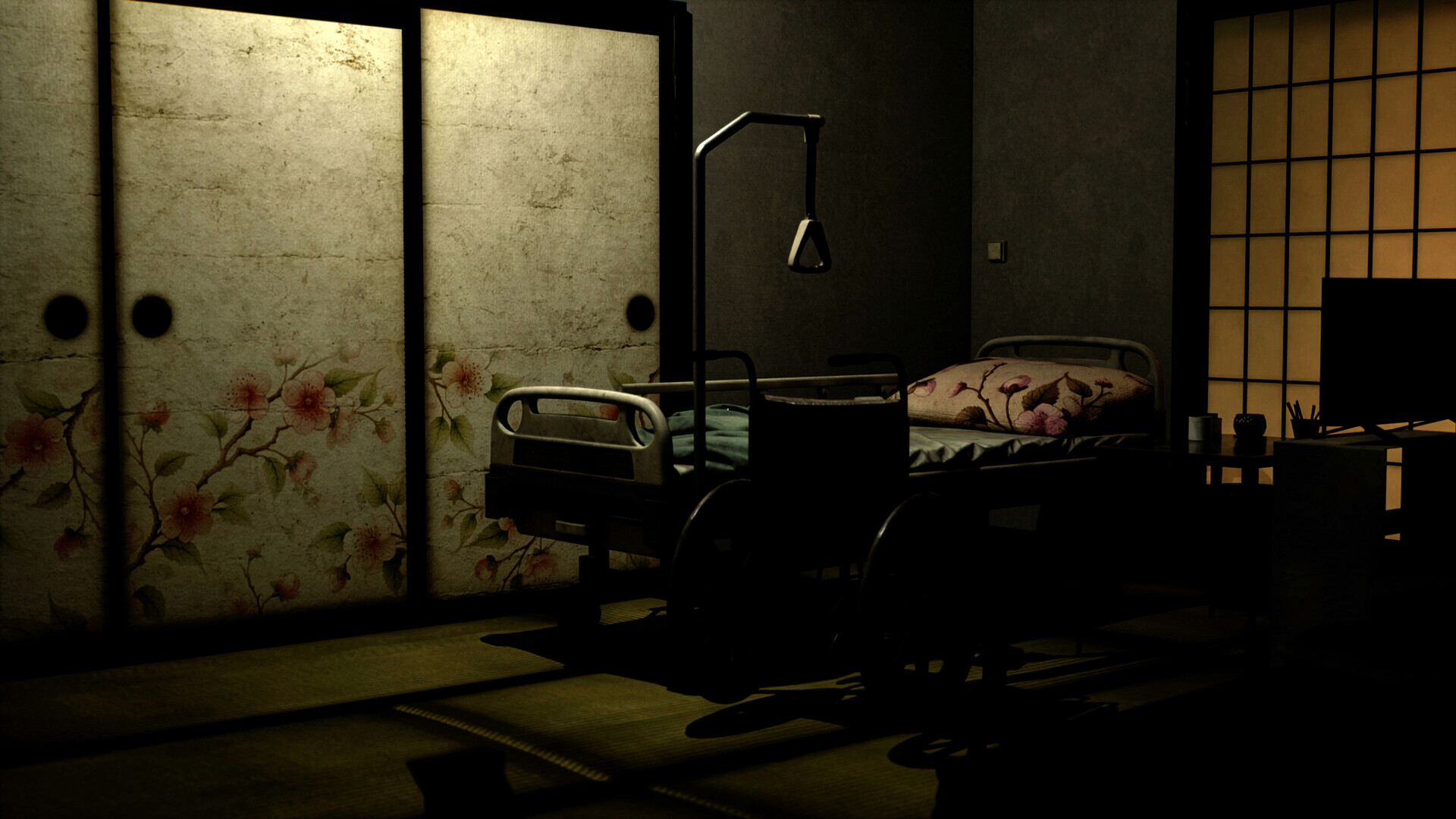
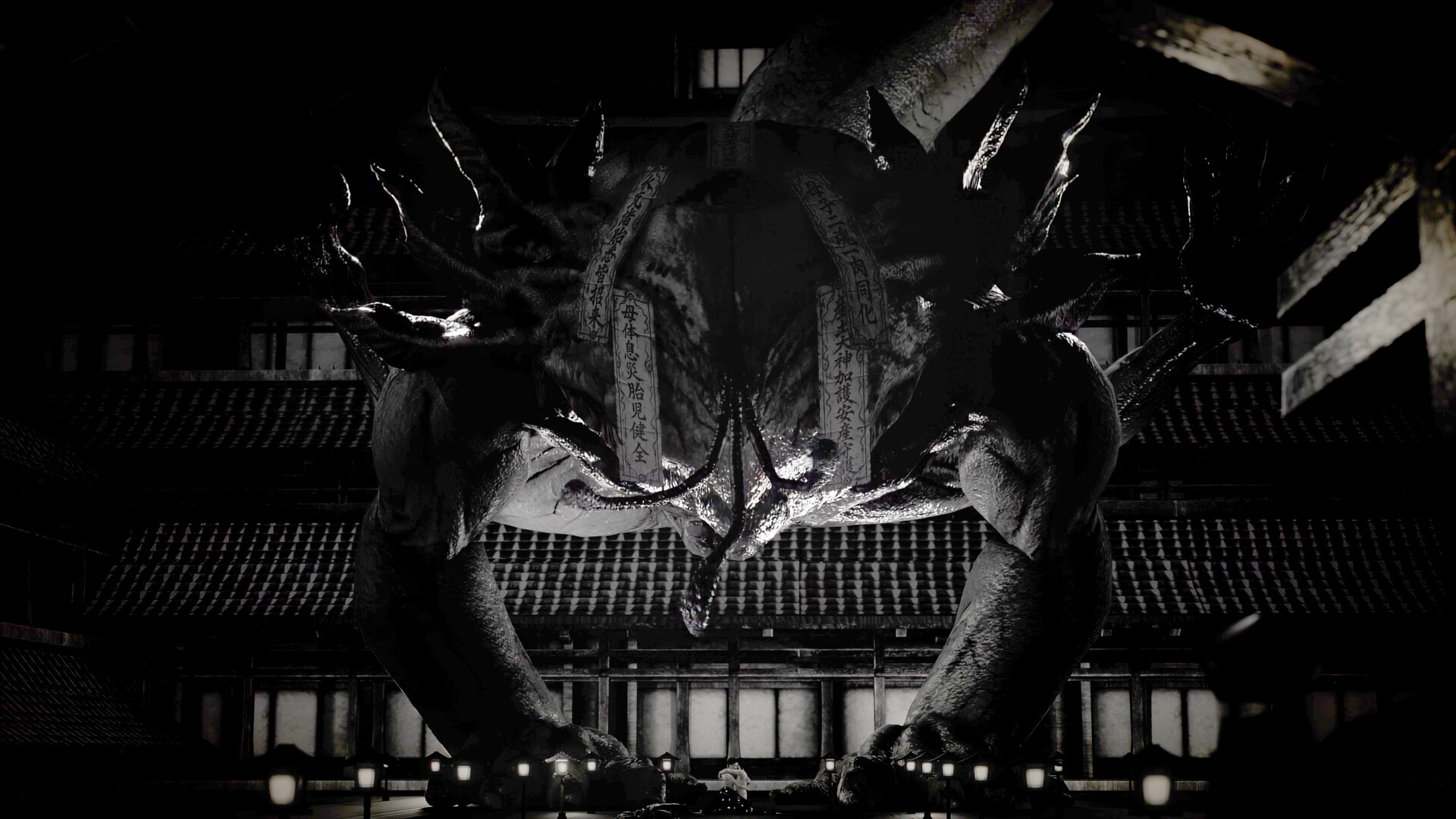
The official screenshots are consistent with a house, and they show more objects than the text names. One frame is the tatami room above, with a hospital bed and a wheelchair. Another, on screenshots, puts a huge creature in a dark courtyard of tiled roofs, with paper strips on its body and a tiny human figure among lanterns at the bottom. A third follows the boy down a black hallway toward a thin figure in a doorway. These are announcement images. They are not labeled rooms, and they are not a level order.
What the tone is for
The store frames the story as a tragedy that could befall anyone, and it says the line between human and monster blurs the further you go. Faith, love, and hatred are the inheritance it names. The official game account's bio, separate from the store essay, calls it a Japanese survival horror inspired by family values. Those are adjacent phrasings of one theme, not extra plot points.
Steam's genres are Action, Adventure, and Indie. The PlayStation concept page's genre is Horror. Both were read on 22 November 2026. Use both labels. The content warning and the age ratings that sit next to this tone are on languages and requirements.
Verdict: Read the premise here, then wishlist on the stores linked from release status. Skip any page that offers a route, a puzzle solution, or a boss order. Those documents do not exist yet, and inventing them would pretend the game is already out.
What remains unpublished
No save system, no difficulty list, no co-op mode, and no mod support appear in the store categories or the about text. The categories that do appear are single-player, custom volume controls, DualShock controller support, stereo sound, partial controller support, and family sharing. "Partial controller support" is a store flag. It is not a control scheme. Credits covers who is allowed to speak for the game, which matters because September articles described tools the current store text does not mention.
All pages in this section
FAQ
Is the Kamata family a real place?
The stores present the Kamata family as the game's family, inside a secluded estate. They do not identify a real address or a real historical house.
Is the creature in the courtyard named on Steam?
No. The about text says the family has worshipped a being. It does not print that being's name under the screenshot.
Is this a walking simulator or a survival game?
The description calls it a third-person survival horror, with exploration, puzzles, limited resources, and two different ways of meeting the supernatural. Steam's genre chips are Action, Adventure, and Indie. PlayStation's genre chip is Horror. Those chips and the description are different labeling systems, which the FAQ also keeps side by side. The stores do not publish a systems list beyond that.
Sources: Steam English and Japanese store text, PlayStation concept pages, official screenshots, 22 November 2026